


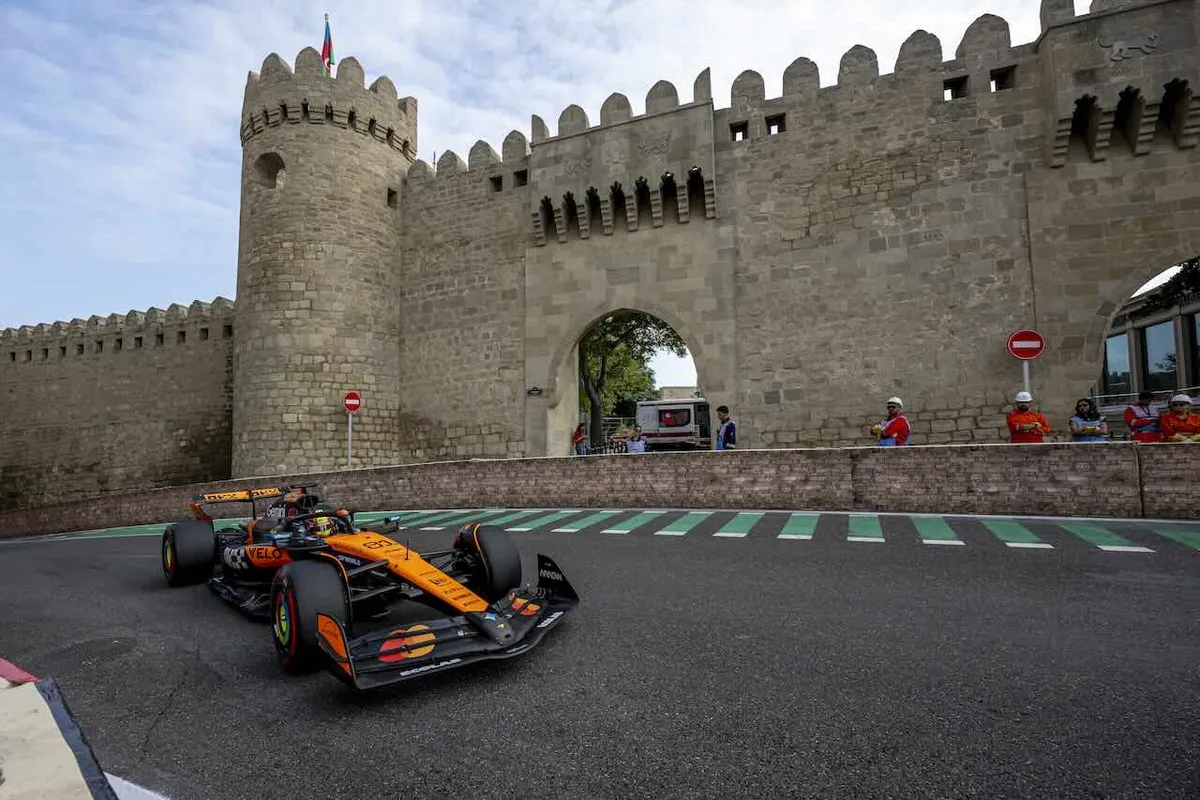
Azerbaijan Grand Prix
Norris holds off Piastri by 0.043s in tense Baku qualifying duel
Eleanor Hartley · 23 Sept · 2 min read
Constructor · P3 · 316 pts
McLaren
| Rd | Grand Prix | Best finish | pts |
|---|---|---|---|
| 1 | Australian GP | P5 | 10 |
| 2 | Chinese GP | P19 | 8 |
| 3 | Japanese GP | P2 | 28 |
| 4 | Miami GP | P2 | 48 |
| 5 | Canadian GP | P11 | 12 |
| 6 | Monaco GP | P4 | 12 |
| 7 | Barcelona GP | P3 | 25 |
| 8 | Austrian GP | P4 | 18 |
| 9 | British GP | P4 | 20 |
| 10 | Belgian GP | P5 | 16 |
| 11 | Hungarian GP | P1 | 25 |
| 12 | Dutch GP | P1 | 43 |
| 13 | Italian GP | P4 | 22 |
| 14 | Spanish GP | P3 | 19 |
| 15 | Azerbaijan GP | P13 | 0 |
| 16 | Bahrain GPin Malaysia | P6 | 10 |
McLaren are Britain’s most prolific Formula 1 team after Ferrari, founded by Bruce McLaren and based in Woking. They matter now because, after a long rebuild, Andrea Stella’s Mercedes‑powered outfit won the constructors’ championship in 2024 and 2025 and, with the 2026 season still in progress, sit third on 316 points with two wins.
Bruce McLaren established Bruce McLaren Motor Racing in the early 1960s and took the team into Formula 1 mid-decade. By the early 1970s McLaren had become a front‑running force. Constructors’ honours arrived in 1974, the team scoring four wins en route to the title, and they remained a consistent contender through the decade. After finishing runners‑up in 1976 with six wins, the founder’s death in 1970 ushered in new leadership and a more corporate structure.
A merger with Ron Dennis’s Project Four organisation at the start of the 1980s reshaped McLaren’s future. The team returned to title contention in 1982 and clinched back‑to‑back constructors’ crowns in 1984 and 1985, winning 12 and six races respectively. A second wave of supremacy came with Honda power: from 1988 to 1991 McLaren took four consecutive constructors’ championships, including a record 15 wins in 1988. They remained title contenders in the early 1990s, finishing runners‑up in 1992 and 1993.
The mid‑1990s brought transition before McLaren surged back to the top with Mercedes power at the end of the decade. The 1998 season yielded the constructors’ championship with nine wins, and they finished runners‑up in 1999 with seven victories. In the early 2000s they posted second in 2000 and 2001 and third in 2002 and 2003. The 2005 car was often the class of the field on Sundays, taking 10 wins, yet the team placed second in the standings. A turbulent 2007 produced eight wins but no constructors’ points after disqualification, before they rebounded with six wins and second overall in 2008 and stayed a top‑three force through 2012, including five wins in 2010, six in 2011 and seven in 2012.
The hybrid era exposed weaknesses that took years to correct. From 2013 to 2018 McLaren did not win a race and often sat in the midfield, their lowest ebb coming in 2015 with ninth overall and 27 points. A gradual reset returned them to relevance: seventh in 2018, then fourth in 2019 and third in 2020 with 202 points. They won again in 2021 and finished fourth with 275 points, then logged fifth in 2022 and fourth in 2023 as the Woking group rebuilt its technical structure and refined its car concept. Throughout that period McLaren remained anchored at the McLaren Technology Centre and cycled through engine partnerships before reuniting with Mercedes power.
The rebuild culminated in 2024 when McLaren, led by team principal Andrea Stella and using Mercedes power, won the constructors’ championship with 666 points and six victories. They were even stronger in 2025, taking the title with 14 wins and a towering total of 833 points. The current 2026 season remains unfinished; the team is third with 316 points and two wins, well placed but with work to do in a tight fight at the front.
After early consolidation in the 1970s they were champions again and again: titles in 1974, 1984, 1985 and a four‑year sweep from 1988 to 1991, then a further crown in 1998. They finished second or third a dozen times across different regulations and power units, including runners‑up in 1986, 1987, 1992, 1993, 1999, 2000, 2001, 2005, 2010 and 2011. Their low points were stark — eighth in 1978, ninth in 1980 and 2015, and the unique outcome of 2007 when eight wins sat alongside a constructors’ disqualification — yet the pattern has been one of return. Recent seasons trace a clear ascent: fourth in 2019, third in 2020, fourth in 2021, fifth in 2022, fourth in 2023, then champions in 2024 and 2025.
Founded as Bruce McLaren Motor Racing, reshaped by the Project Four merger into the modern McLaren International construct, and now operating as McLaren Racing from Woking, the team’s engine partnerships have included Honda during the late‑1980s dominance and Mercedes in multiple spells; today they run Mercedes power. Stability on the pit wall under Andrea Stella has accompanied their return to form, while Woking remains the base from which their F1 effort is designed, built and managed.
In the mid‑1980s they amassed 12 wins in 1984, followed by six in 1985. The 1988 season’s 15 wins remain one of the sport’s defining campaigns, and the late‑1990s resurgence produced nine wins in 1998 and seven in 1999. Even in seasons without titles, they were often the team taking multiple victories, as in 2005 and 2011. Most telling is the recent step: six wins in 2024 and 14 in 2025 show a modern McLaren as potent as any in their history, and while 2026 is not yet complete, two wins already keep them in the conversation at the front of the field.
Azerbaijan Grand Prix
Eleanor Hartley · 23 Sept · 2 min read